
Snoking1127
Well-known member
I tow strap off the front to a 4 wheeler!!!What diameter tire would I need on my 2010 to hit 40 mpg? Getting 27mpg now....

I tow strap off the front to a 4 wheeler!!!What diameter tire would I need on my 2010 to hit 40 mpg? Getting 27mpg now....


Now far a serious question. What would a Stage II upgrade do for MPG on my bike as long as I don't change my riding style much? Knowing it will cost approximately $500 for the upgrade, will it ever pay for itself? To date since I have owned the bike my gas cost is $103.42/1000mi. Also I realize that once I have the upgrade I can never use less than 91 octane. I pretty much do that now anyway. My financial advisor (wife) will want to see the payback period. We ride a lot. Presently don't have a problem with performance, just wanting to squeeze out as much efficiency as I can. Already have installed the Cat delete and use the spark plug upgrade.


Yes. Stage II will NOT increase your MPGs. However, if used incorrectly, it can quickly put you in a position you may not want to be in. It's fun to play with, but do it safely. Anticipate its speed and be ready for it when it comes in.So really, it's unlikely that a Stage II ECU Upgrade (or any ECU Upgrade) on a 1330 will ever actually 'pay for itself' per se - except maybe in the enjoyment you get from your riding, and that's gonna be somewhat personal and extremely subjective, and likely somewhat greater the more you DO 'change your riding style' to take advantage of the better responsiveness and performance, higher revs, etc, etc!


If you are running the OEM Kenda, it will wear in the middle regardless of tire pressure. Overpressuring any tire will give you better fuel mileage. It will tend to reduce the contact patch and stiffen the contact area. Both will reduce roll resistance which is good for fuel mileage.According to my manual, it says that my 2023 RTL should have 28 psi in the rear tire. I'm wondering if I increase the pressure by a few pounds, if that will increase my fuel mileage. I understand that some people have mentioned the tire wears out in the center of the tread if the tire pressure is too high. But what is too high?
According to my manual, it says that my 2023 RTL should have 28 psi in the rear tire. I'm wondering if I increase the pressure by a few pounds, if that will increase my fuel mileage. I understand that some people have mentioned the tire wears out in the center of the tread if the tire pressure is too high. But what is too high?
 However, any improvement in fuel economy achieved by just varying the tire pressure, especially if it's by anything less than about 20%, is likely to be around 2/5ths of 5/8ths of absofreakinlutely sweet... VERY LITTLE, and given the OEM tires and their lightweight construction (and their renowned poor quality control!
  ) the increased risks of catastrophic tire failure thru varying their tire pressure much at all will far outweigh any potential (minimal) benefit!
Tire weight ratings are base on ply ratings/inflation table and max speed rating. If lowering the inflation creates lower capacity, lower max speed increases capacity. There is no issue with car tires when inflation is decreased to account for the lighter load. Driving over a piece of white paper can be used to see the foot print the tire is putting to the ground at a given inflation. Or just go with what others are doing and inflate your front car tires to 16-17 lbs and the rear to 18-19. Ride ON!Ron and Peter have it down to pretty much what's what when it comes to MPGs and tire wear. Think about it. BRP designed a Spyder but did not design tires for it. So we're left with what we've got to choose from. We're riding a 1K pound vehicle and using tires designed for a vehicle weighing 4 or 5K. On top of that, our Spyder's rear tire is only supporting half of that. 500 pounds and the front two only 250 pounds each. There's nothing out there designed to meet those needs for max performance or safety. We just have to do with what we've got... for the time being. Don't waste your time overthinking it because you can't. If you want to play around with it, find yourself a large empty blacktop parking lot that's dry on one side and wet on the other side. Get your tires wet on one side and drive around on the dry side, and watch your tire patterns. But remember, the tire patch will change at highway speeds. I've found that about 18 PSI is the sweet spot for me in terms of wear and performance. Good luck, be safe, and have fun all at the same time.

I figure a 6 ft diameter rear tire should improve mpg... checking Amazon now.
 I can't find a pic of the specific bike I'm thinking of atm, but here's one that's heading that way: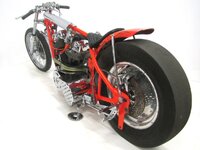

A larger tire increases traction and can give you a greater MPH range in each gear. Assuming you don't have to gear for the added dimension.
 ) can increase the traction provided by a tire, especially if the larger tire results in a longer contact patch rather than a wider contact patch (which, oddly enough, can actually increase lateral or turning traction, but reduce driving/braking straight line traction! ); but if it becomes too much of an increase in contact patch area, the lesser force exerted on the ground will begin to reduce the overall traction provided.


