• There were many reasons for the change of the site software, the biggest was security. The age of the old software also meant no server updates for certain programs. There are many benefits to the new software, one of the biggest is the mobile functionality. Ill fix up some stuff in the coming days, we'll also try to get some of the old addons back or the data imported back into the site like the garage. To create a thread or to reply with a post is basically the same as it was in the prior software. The default style of the site is light colored, but i temporarily added a darker colored style, to change you can find a link at the bottom of the site.

Anybody see a measurable change in fuel mileage with larger diameter rear tire?

Tslepebull

Active member
I am considering changing the 225/50-15 OEM tire on my Canyon to a 205/60-15 (probably Vredestein) before a long trip this summer. I was looking at data on an on-line vendor where I could compare specs from the OEM to the larger diameter Vredstein. Apparently the narrower/taller replacement tire would turn some 3-5% fewer revolutions per mile. This leads me to question if anyone has noticed a change in fuel economy after making a similar change? Presumably fewer rear wheel revolutions per mile would result in less fuel per mile. Not that this is a big deal compared to a better constructed /longer lasting tire just value added.
 
I am considering changing the 225/50-15 OEM tire on my Canyon to a 205/60-15 (probably Vredestein) before a long trip this summer. I was looking at data on an on-line vendor where I could compare specs from the OEM to the larger diameter Vredstein. Apparently the narrower/taller replacement tire would turn some 3-5% fewer revolutions per mile. This leads me to question if anyone has noticed a change in fuel economy after making a similar change? Presumably fewer rear wheel revolutions per mile would result in less fuel per mile. Not that this is a big deal compared to a better constructed /longer lasting tire just value added.
It will correct your speedo about 1 MPH, noticeable effect of fuel mileage is not going to happen.
 
With a 3-5% reduction in revolutions, your measured fuel mileage would go down 3-5%. But in reality, you're going 3-5% further for the same mileage reading, giving you a wash. There are other factors involved. But essentially, though your math may indicate a reduction in fuel mileage, your actual fuel mileage will be nearly identical.
 
Last edited:
I've actually tested a lot of these different tire sizes, properly, on a track, over accurately measured distances with scientific and recently calibrated instruments, and really, any difference you might find with any lesser testing is likely going to be pretty small if not completely inconsequentially tiny AND potentially misleading; unless you REALLY get down into the minutiae/nitty gritty of it all, and absofreakinlutely start matching the tiniest bits of the vast range of potential variables before doing the comparison, like having your tires before & after set to exact fractions of air pressure at a specific ambient temperatures running on a specific road surface that's a defined temperature at exactly the same time of day, cloud cover, sun inclination, et al)... And if you don't do this, then you'll likely either get some fairly useless data &/or just rapidly confuse/upset yourself and everybody around you, and you'll still probably only get results that aren't really valid enough to have any significant impact beyond your personal 'for interests' sake, but are also very likely going to different if not the opposite of what you might expect, and besides, because of the limitations in how you can measure/rationalise and include allowances for all the potential variables in your calcs, nothing's really 'exactly the same' &/or even 'correct' per se, let alone 'accurate' anyway... 😖

Consider this - a taller tire that turns fewer revs per mile should theoretically give you better fuel economy, shouldn't it - travelling a further distance each rev? Yeah, but how did you measure how far you travelled in total &/or how much fuel you truly used?? If you used the speedo/odometer/trip meter on the Spyder to measure your speed &/or distance travelled, then because of the larger dia tire travelling further with each revolution than what it was doing with the OEM tire, the distance shown on your odo/trip meter will also have been changed too, so you can't compare it to your before calcs - it'll be reporting shorter total distance travelled over the same number of revs, cos unless you've reset them, your Spyder's computers still think you're doing 'x revs per mile', only you're actually now doing 'x minus some' revs per mile. And even if you think you've run over a given measured distance at exactly the same indicated speed on your speedo &/or GPS, there's discrepancies built in there too (even your GPS isn't really exactly accurate, altho it's likely better than your odo/trip meter, but then there's also variables based upon how many satellites it's acquired and how high/far away they are etc...) And then there's the pressure you're running in the (new, old, whichever) tires - that will vary its effective rolling diameter too, so there's more variance; and the new tire's 'revs per mile' is going to be different to whatever that was with the OEM tire, even more so if the barometric pressure is different today to whatever it was last week; so effectively, it all boils down to whatever you might think gain/lose in the way of fuel economy on the teeter totter, you'll likely lose/gain that or more on the see saw, &/or vice versa... And really, there's only ever gonna be 2/5th's of 5/8th's of a bee's whisker in it anyway - IF you can rationalise &/or cater for all the potential variables!! :eek:

Yep, that truly is a 'big IF'! o_O
 
But how much more does the larger tire cost than a normal sized tire?

And what kind of fuel mileage increase would be required to offset that cost over the life of the bigger tire?
 
But how much more does the larger tire cost than a normal sized tire?

And what kind of fuel mileage increase would be required to offset that cost over the life of the bigger tire?
The Generals that I put on the rear are 121 bucks. What does the Kenda rear tire cost? The General Altimax RT45 215/60R15 is a much better tire. Spyder handles better and it will last 3 or 4 times longer.
 
I record every trip by bike odometer and GPS odometer. Last year bike odometer recorded 15,509.5 and GPS was 15,616.4. Basically got 106.9 miles for free. Mileage was 37.62 for odometer and 37.88 by GPS. The most important thing was the original Kenda was changed at 10,355 miles and was scary handling in wet conditions. The last Vred 205/60 was changed out at 28,896 miles with only slight degradation in wet conditions. The Vred lasted 2.8 times longer. The rear tire is in my opinion the 2nd worst maintenance item behind the spark plugs. More ride time, less shop time!
 
I record every trip by bike odometer and GPS odometer. Last year bike odometer recorded 15,509.5 and GPS was 15,616.4. Basically got 106.9 miles for free. Mileage was 37.62 for odometer and 37.88 by GPS. The most important thing was the original Kenda was changed at 10,355 miles and was scary handling in wet conditions. The last Vred 205/60 was changed out at 28,896 miles with only slight degradation in wet conditions. The Vred lasted 2.8 times longer. The rear tire is in my opinion the 2nd worst maintenance item behind the spark plugs. More ride time, less shop time!
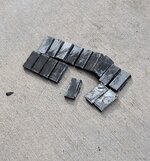
Here are the weights removed from the rear wheel of my second 2018 when the Kenda was removed. A General Altimax Rt45 was installed without balancing and has no issues. I have done 4 rear tire R&R now between my Spyders and friend's Spyders. Not the funnest job, however having the right tools including a BIG torque wrench helps.

My newest 2018 with only 4100 miles on it will get Vredesteins and a General when I get back to Washington in May and see it for the first time. My son up there handled the viewing, receiving, paper work, and storing of this one. I am debating on whether to put on 175/55R15 on slightly wider PPA Orb wheels or 165/60R15 on the OEM wheels.

Copped 2.jpg
 
Last edited:
This conjurs up the biblical visual described by Jesus in Matthew 23:24 (to strain at a gnat, and swallow a camel). Granted, I've taken this quote out of context, nor do I mean to infer the original intent upon anyone in this thread. I hope the analogy is not offensive.

Every decision is a process of elimination based upon priorities. Because there is no 'Perfect Product'.

My order of importance for tires on my Spyder. Some aspects are predetermined and not subject to alteration. Fitment would be one of these. I also stay away from cheap, no name tires. I've found them to be worth even less than the original price. But again, if price is at the top of your list, then your tire choice may be different than mine.

1- Wet & Dry Traction.
2- Handling
3- Reliability (construction quality, tread material, etc.)
4- Ancillary improvements (such as more accurate speedometer, improved ride, & tread life)
5- Cost

In my tire assessment, I leave fuel mileage out for 2 reasons. First, the Spyder is a toy. I didn't purchase it for fuel mileage. I have a VW E-Golf and Sportwagen TDi for this.

Second, the fuel mileage range between tires is going to be small. Maybe as much as 2 mpg (+ or-). But that would be extreme. You'll get much greater results by reducing your Interstate speed by 5 mph. But who of us is willing to do that? Why? Because the event is more important to us than fuel mileage.

I am also willing to sacrifice tread life for improved Wet & Dry traction. In your assessment, you may want to swap these and put tread life at the top. That may well change your final tire choice.

Fuel mileage is an interesting topic. I enjoy the discussion. But in the real world, it really is a non-starter.
 
If I was really concerned about fuel mileage I would give up my vroom vroom "personal rush" on freeway on ramps and/or from stop sign/stop lights!!!
 
Last edited:
Really the fuel mileage was more of a curiosity for me. The Canyon already gets better fuel mileage than my Ryker Rally did. Replacing the OEM tire with the Vred is (for me) more about wet weather control and durability. I have experienced the tarstrip hop and rear tire fishtail with the OEM rear tire while riding in heavy rain; I was not a fan.
 
Last edited:
If I was really concerned about fuel mileage I would give up my vroom vroom "personal rush" on freeway way on ramps and/or from stop sign/stop lights!!!
Exactly! You don't have to ride like Evil Keneivl to know that fun is the primary factor for owning a Spyder.

It's All About The Ryde!
 
Back
Top