• There were many reasons for the change of the site software, the biggest was security. The age of the old software also meant no server updates for certain programs. There are many benefits to the new software, one of the biggest is the mobile functionality. Ill fix up some stuff in the coming days, we'll also try to get some of the old addons back or the data imported back into the site like the garage. To create a thread or to reply with a post is basically the same as it was in the prior software. The default style of the site is light colored, but i temporarily added a darker colored style, to change you can find a link at the bottom of the site.

Another Ryker Sway Bar thread - Gravel Handling! Any upgraded sway bar owners? Do they make any difference, for better or worse, on Gravel?

nightfalcon

Active member
I've read a lot of upgraded sway bar reviews and comments but can't find much from Ryker owners who ride loose and rough gravel roads regularly. I don't need any convincing that they will improve cornering on sealed roads, but I ride a lot of unsealed roads...

In a perfect world, stiffening the sway bar should be counter productive for 'off roading' but as far as I can tell, all the data comes from serious 4 wheel rally cars racing at high speeds, not a 3 wheeled trike slipping around on gravel roads at 30-40 kph.

Are there any upgraded sway bar owners riding gravel service roads out there who can add to the discussion? Does it make any difference, for better or worse?
 
Never considered it, but I drive a lot on gravel roads through hunting and game lands on my F3 to get to some secluded areas.

Never had to worry about sway bar performance, as I just go at a crawl on the gravel with the low clearance on the F3.

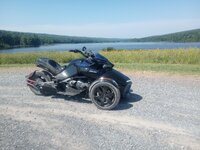
IMG_20250804_154432338.jpg
 
Rally cars have anti roll bars, or sway bars, that vary in stiffness depending upon what the stage is like, what the surface is like, and are often a compromise over the stage as a whole.

Softer anti roll bars are often used to get better articulation and traction on rough surfaces.

Sometimes they have linkages that can be changed from inside the car, like a sort of disconnection feature. However, stiffening the front can promote understeer or correct oversteer. It’s a careful balance for a rally car.

Obviously, a Ryker has limited suspension articulation and a very fixed steering geometry with only an anti roll bar at the front. The rules that apply to rally cars may be different to those applied to a trike.

Rally drivers often have a very personal way of setting up their vehicle's anti roll bars that suits their driving style as much as a generalized rule for the terrain. Modern rally cars are AWD too, which makes their handling different from bump steer at the front and the dished front and rear balance in traction.

It might well be true of your Ryker too, a question of how it applies to your riding style and how you like it to feel. There are probably not any hard and fast answers to your questions, as the baseline OEM fitment might be still be too soft, or it might be too hard.
 
Rally cars have anti roll bars, or sway bars, that are varied in stiffness depending upon what the stage is like, surface like, and are often a compromise over the stage as a whole.

Softer anti roll bars are often use to get better articulation and traction on rough surfaces.

Sometimes they have linkages that can be changed from inside the car, like a sort of disconnection feature in some cases. However, stiffening the front can promote understeer or correct oversteer. It’s a careful balance for a rally car.

Obviously a Ryker has limited suspension articulation and a very fixed steering geometry with only an anti roll bar at the front. The rules that apply to rally cars may be different to those applied to a trike.

Rally drivers often have a very personal way of setting anti roll bars that suit their driving style as much as a generalized rule for the terrain. Modern rally cars are AWD which makes a different too from bump steer at the front and the dished front and rear balance in traction.

It might well be true of your Ryker too, a question of how it applies to your riding style and how you like it to feel. There is probably not a hard and fast answer to your question as the baseline OEM fitment might be still too soft, or it might be too hard.

A three wheeled vehicle will aways have all three wheels down vs a four wheeler that can lift 1 or 2 wheels at times.
 
A three wheeled vehicle will aways have all three wheels down vs a four wheeler that can lift 1 or 2 wheels at times.

Hmmm, that bit, surely, not always!! :unsure:

At least, not the way I ride?! 😁 That's certainly not the case on the Ryker's I've ridden, which (I feel) seem to be designed to lift a wheel occasionally, especially when on the dirt/gravel; but also not on my 'daily ride' RT, too - regardless of whether it's on the hard stuff or in the loose stuff/on the dirt, even without considering the occasional 'Stoppy'! ☺️

Still, I guess it all comes back to how hard you ride, and how much you push the envelope! We've got lots of great roads here in my neck of the woods, but most of them are unsealed and looong, so if you don't ride on dirt/gravel, you're REALLY missing out on some fantastic stuff - and riding on roads that are as rough as ours at any sort of speed, basically anything much above a slow walking pace, means that:
  1. you can actually get to some great places before you get too old; and
  2. you'll spend a fair bit of time with one wheel in the air, altho admittedly, I do try to avoid getting 2 or more wheels airborne too often!! ;)
Just Sayin' :sneaky:
 
Hmmm, that bit, surely, not always!! :unsure:

At least, not the way I ride?! 😁 That's certainly not the case on the Ryker's I've ridden, which (I feel) seem to be designed to lift a wheel occasionally, especially when on the dirt/gravel; but also not on my 'daily ride' RT, too - regardless of whether it's on the hard stuff or in the loose stuff/on the dirt, even without considering the occasional 'Stoppy'! ☺️

Still, I guess it all comes back to how hard you ride, and how much you push the envelope! We've got lots of great roads here in my neck of the woods, but most of them are unsealed and looong, so if you don't ride on dirt/gravel, you're REALLY missing out on some fantastic stuff - and riding on roads that are as rough as ours at any sort of speed, basically anything much above a slow walking pace, means that:
  1. you can actually get to some great places before you get too old; and
  2. you'll spend a fair bit of time with one wheel in the air, altho admittedly, I do try to avoid getting 2 or more wheels airborne too often!! ;)
Just Sayin' :sneaky:
My point was about a sway bar on a three wheel vehicle off highway. On my Kawasaki KRX 1000 I ran with the front sway bar disconnected most of the time. It helped keep traction with all four tires. A stiffer sway bar on a three vehicle off road at slow speeds is not the same as on a highway!
 
The comments so far are all on the money. I will say that I've had one front wheel off the ground on a number of rides, hitting diagonal ruts running across the road at speed will do that, but I don't have it happen very often on corners, as I'm usually going slower. The steering stabiliser I fitted is also a big improvement in keeping the front planted.

Sway bars, as some of the comments mention, do impact handling to varying degrees depending on how stiff or flexible they are. Of course, riding style, speed, and the road surface are also variables, none of this is in doubt in my view.

My interest is in how much of a difference it makes, for better or worse, on a Ryker (Sport or Rally) on gravel roads in varying conditions. It will be very interesting to hear from riders who have ridden with and without the stiffer bar fitted on their Ryker on gravel, as to whether or not it made that much of a difference... we know that on paper in certain circumstances, it should, but did it?

It might be the case that not many have gone down this road and I'll end up being the beta tester, :cool: I'm always looking for improved handling; a stiffer sway bar will make sealed road riding a lot better, but how much will it actually compromise off road riding is the question...
 
Well, I have not ridden a Ryker on graveled roads with and without a sway bar, but I have had the chance to beat a sled with and without one, and I can say it makes a difference with that! Keeping at least one point of contact up front will keep you out of the rhubarb better that having no wheels on the ground, just my way of thinking anyway! 🙃
 
Back
Top