• There were many reasons for the change of the site software, the biggest was security. The age of the old software also meant no server updates for certain programs. There are many benefits to the new software, one of the biggest is the mobile functionality. Ill fix up some stuff in the coming days, we'll also try to get some of the old addons back or the data imported back into the site like the garage. To create a thread or to reply with a post is basically the same as it was in the prior software. The default style of the site is light colored, but i temporarily added a darker colored style, to change you can find a link at the bottom of the site.

What psi are you running in your Canyon's Rear Suspension Air Bag?

Not sure about the Canyon, but on the 2014 RT and 2016 F3T that had a manual point for inflation, it gave a psi dependent on the weight that was being on the bike (driver, passenger, luggage).
 
Sarah, this is not a one size fits all question, if you are wondering about it, is there something wrong with your ride on your bike that you don't like? For example, is it rough on the bumps, is it bottoming out, or too stiff? Do you carry a lot of stuff on the bike with you? You can put up to 90lbs in the bag, but you will never need that much! Start low and work your way up at like 5lbs at a time until you find a good, happy place that's to your liking! What works for one may not work well for you. Good luck!! ;)
 
Remember adding air to your Spyder's air bag does approximately four things:

1. Inflation increases the ride height.
2. Inflation increases the suspension stiffness in a complex relationship between the air bag spring rate, the mechanical spring rate and the ride height.
3. Inflation effects the geometry of the Spyder by raising the rear of the bike unless this is offset by an increased load to level it out.
4. Inflation will to some extent effect handling slightly due to item 3, the slight change in steering geometry due to 1, and the stiffness of the rear suspension due to 2.

So, mainly the objective is to add just sufficient air to have the Can Am designed ride height, depending upon the load on the bike. That's what the automatic system does, it reads the ride height sensor and adjusts the air pressure until the sensor reads the bike at its designed normal ride height.

Now, not wanting to make assumptions about your weight (I know I'm on dodgy ground here) and the luggage you carry, usually for a single rider I have found the pressure to normally be between 25 to 50 lbs.

Making the assumption you are, say, 140 lbs and without a passenger and luggage, I would start off at 30 lbs. If the bike feels too harsh at the rear over sharp bumps, I would come down to 25 lbs. I don't think you'll need to come down much below that. If the bike bottoms out over bumps (not the same as being harsh) and the rear bounces and floats too much, keep adding 5 lbs until it feels right. I'm 230 lbs and my solo pressure is about 50 lbs.

Part of it is setting where it feels right between bottoming out and feeling too harsh. But a lot of it is taste. Sometimes you might want to set it a bit harsh if you know you are going to load stuff on it at the store or pick up a passenger.

As far as I have read, the reliable limit is about 90 lbs/sq in. Do not inflate with a pressure tank or workshop compressor, like they use at a tire store, or even a tire inflation station at a gas station. The volume in the system is very small and it is easy to over stress it. Either a hand or foot pump, or a portable inflation unit that seems to take ages to inflate a tire. Note, every time you measure the pressure with a gauge you'll lose a few PSI too. On the automatic systems, the pump is very small and takes quite a while to inflate the system.

Once you get a pressure you like, measure the height of the center of the rear axle above the ground with nobody on the bike. Write that value in mm with a Sharpie on the inside of say the trunk lid. Then you can set the pressure any time by inflating to restore that height if you don't happen to have pressure gauge with you. It should put you in the ball park.

Note, remember to keep the tire pressures set accurately. Usually with OEM tires they run 20 lbs at the front, same each side is important, and 28 lbs at the rear. The rear tire pressure will effect the spring rate of the rear as it is part of the suspension so keeping a consistent pressure in the rear tire will help you be consistent with the suspension feel from the air you add to the air bag.

The automatic system just keeps the bike's rear at the Can Am designed ride height. With the manual system, you can adjust this up or down to a level you are comfortable with giving you an infinite choice in how the bike feels, which is both a blessing and a curse.

Good luck.

I hope that helps.

 
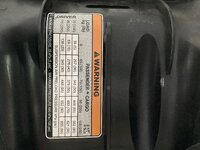
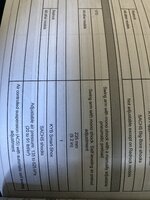
Thanks so much everybody. This is my first go round with this sort of suspension and I should have explained the reason for my question rather than just ask it the way I did. If I’m reading things right the seat sticker and the manual vary too much to make sense.

IMG_3101.jpeg
IMG_3102.jpeg

What do you all think? I’m about 125 with helmet and jacket and always have the side cases on the bike, so I figure that’s right around 150 lbs.

Sarah
 
For my Canyon I tried to extrapolate from the 5 lbs on the chart for 150 lb rider (no passenger) then added 1 lb for the weight of the side and top cases empty. I tried up to 8 lbs but found that to be a bit bouncy going over bumps and settled on the aforementioned 6.
 
Hey Sarah. Your second picture from the Tech Spec page of the manual, is a copy and paste by the tech writers from the RT manual. Historically, we've seen a lag between introduction of a new model and the manuals catching up to the current specs. Not to mention assorted math errors when converting metric units. All the models use the same air bag. They're just operated at different pressures. The sticker under the seat, and the picture of it on page 8-12 of your manual would be the one to operate by. Ride Safe.
 
Last edited:
The info I gave you earlier, sorry, the numbers were for an RT LTD or S2S not a Canyon.

However the principle is the same. Adding enough air to keep the thing at where the bike with auto leveling would keep it from the ride height sensor.

At 125 lbs plus empty luggage 5lbs would be indicated from what I can see.

For me on a S2S obviously with my weight and the bikes weight, I’m running pressures at around 30-50 lbs.

Even if you have 0 psi, the air bladder will still have air pressure and be part of your suspension as all these pressures are for amounts above atmospheric pressure.

For the altitude I live and ride at, I need up to 15% more pressure than would be indicated as ambient air pressure is lower. So depending upon where you live altitude wise, you may have to add a bit to compensate. I suspect the table under the seat was probably a sea level estimation, or close to it.

With your body weight you might want to start at a few psi and work up a few psi at a time.
 
Back
Top