When you say better friction reduction do you mean flowability?
There is more than one source of friction. Flowability is one. Resistance between mated and moving components is another. Flowability affects the time between when the oil pump begins to turn and pressurized lubricant is delivered to remote components. Thinner fluids flow faster than thicker fluids.
Think about the difference in effort to suck a shake through a straw as opposed to doing the same with a Coke. This is an exaggeration when it comes to this subject, but you get the point.
Theoretically, mated spinning components will have more friction until pressurized oil reaches them. However, a true synthetic oil is proven to stay with parts better than a type III base lubricant. Which reduces startup friction.
There is also stiction, which is a combination of two words. Static and Friction. When there are two components touching each other, a specific force is required to get them to move. And a certain amount of force to keep them moving.
Increase stiction and you increase the amount of energy the starter has to produce. This can, and does, slow your crank speed.
A multi-viscosity oil is thicker at startup than it is at operating temperature. The low number and high number are relative viscosities based upon temperature of the lubricant. Not a direct comparison. Type III lubricants use an additive package to acheive the viscosity spread. True synthetics requre very little in the way of additives. Additives are not lubricants, they are modifiers. Additives are added to address the inherent instabilities of the base oil. True synthetics are Inherently stable and simply don't need much in the way of additives.
A thicker oil will create more friction between parts than a thinner oil. This is why many manufacturers recommend a 0/20 oil or other very thin oils. Less friction, better fuel mileage. But thinner oils may not, and usually don’t, protect mated parts as well. So, you’re trading a mile or 2 better fuel mileage for higher engine wear.
But the oil can be so thick that it also fails to protect mated parts. For example, a 50-weight oil is almost always too thick to efficiently protect friction parts. But the upper number is the viscosity rating measured at 212 degrees. Below this temperature, the viscosity is higher. Above this temperature, the viscosity is lower.
So, you can see where I am going with this. The oil in an air-cooled Harley, for example, can get much hotter than 212 degrees. Especially the oil that is unlucky enough to come into contact with the upper cylinder walls (which can reach and exceed 400 degrees). What happens to your 50-weight then? It can easily thin to 30-weight. But that’s exactly where it needs to be to protect those parts. In this situation, the engineers compensate with an overweighted oil to achieve the desired results.
In an air-cooled engine such as the Spyder, a 50-weight oil is rarely needed. Because nowhere in the engine are temperatures high enough to require it.
Always remember. Everything in this life is a trade-off.
Thinner flows better at startup, can improve cranking speed, delivers oil to remote parts more quickly, will give you better fuel mileage, and can increase engine cooling properties (as long as it is not so thin that friction is increased). But thinner also shears more readily. So, it starts thin and gets thinner. Too thin will not provide adequate separation between mated components which can increase friction and wear.
Thicker oil protects friction components better, preventing wear. But too thick can be detrimental to engine cooling, increase startup friction, and delay lubricant delivery to remote parts. Thicker will give a slight reduction in fuel mileage.
Oil is what I call a ‘Goldie Locks’ item. You don’t want it too thick, and you don’t want it too thin. You want it ‘Just Right’, if that is possible. Unfortunately, there is a lot of less than accurate information mixed into this realm. Including less than honest marketing. It is no wonder that people come away confused.
I've heard opinions that range from ‘All oil is the same, just get whatever you like and stick with it’, to ‘There is only 1 oil that does the job.’ Neither is true. Oils are definitely not all the same. You should put some thought into your choice of lubricant. And there are certainly more than one that will do a good job for you.
The last thing that I will say here, and I've said it before, is that BRP sells what they have. When the Spyder first came out, BRP had a specific lubricant for everything they made. And a 10/40 oil was recommended for the Spyder with a recommended 4,500 mile service interval. Today, there are only 2 lubricants for everything BRP makes.
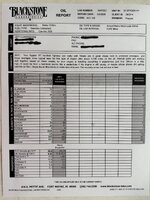
Then you will say 'But Ron! But Ron! That was a 998 V-Twin! We are now running a completely different engine!' And I will say that you are exactly right. A very good point indeed! However. All the oil analysis that we've done shows that the 1330 treats the oil (viscosity wise) exactly like the previous V-Twin did. The oil begins to sheer drastically after about 4,500. Ending up at 20 weight at 5,000 miles on both machines. This suggests that the service interval for the original Spyders took this fact into account.