• There were many reasons for the change of the site software, the biggest was security. The age of the old software also meant no server updates for certain programs. There are many benefits to the new software, one of the biggest is the mobile functionality. Ill fix up some stuff in the coming days, we'll also try to get some of the old addons back or the data imported back into the site like the garage. To create a thread or to reply with a post is basically the same as it was in the prior software. The default style of the site is light colored, but i temporarily added a darker colored style, to change you can find a link at the bottom of the site.

1985 Honda GL1200 Limited Edition Computerized Fuel Injection System Upgrade

Have mentioned specific tuning and new CFI configuration regarding the IAC system upgrade, and using LTFT for VE table calibration.

A small tuning aspect is to compensate for the different fuel injector latencies. I have checked Tuner Studio and could not find a fuel injector offset calibration; however, the MaxxECU has this function. The premise is that injector latency can have a cylinder operate in a lean or fuel rich condition. This is true and I have experienced it. This is the main reason that fuel injector data is very important.

I have OEM Bosch 360 cc/min fuel injectors that have the OEM latency information for each individual fuel injector provided. The ECU settings can be for a "gain" setting used for higher power up to full power, or for an "offset" setting for low powers and engine idle. I am more interested in the "offset" calibration.

The base injector latency is an average of the four injectors or can be a chosen value that would be appropriate. The four injector latencies are: injector 1 - 0.41ms; injector 2 - 0.355ms; injector 3 - 0.368ms; injector 4 - 0.41ms. You can choose either the upper value of 0.41ms, or the lower average value of 0.36ms for the base value.

Using a base injector latency setting of 0.41ms, in the injector calibration section under Offsets, set the injector offsets to: injector 1 - 0.0; injector 2 - (-0.6); injector 3 - (-0.42); injector 4 - 0.0. When the ECU calculates the injector pulse width using a base latency of 0.41ms, the injectors that have a lesser injector latency are being held open for longer than necessary and the affected cylinder(s) will operate in a fuel rich environment. If the injector latency is greater than the base injector latency, the affected cylinder(s) will operate in a lean fuel environment.

You can use the lower injector setting of 0.36ms. This would make injectors 2/3 have a "zero" calibration and injectors 1/4 have a calibration of 0.05ms.

Having mentioned this, injector offsets will be used but after the VE tables are better calibrated.

Just another aspect of engine tuning with an aftermarket ECU.
 
It's in post #3. Sequential fuel and ignition. Best option for this old girl. A new aftermarket stand alone ECU makes this rather "easy" relatively specking. Keeping the OEM wasted spark and paired fuel injection keeps component cost down, but you're dealing with components that have no component data scubas latency, dwell times and a person will need to sped additional time experimenting with component settings to dial in the engine tune. Sometimes it's better and faster to use an "out with the old and in with the new' philosophy.

Time to update the new configuration:

MaxxECU Sport
Sequential fuel and ignition
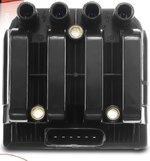
Spark units have been replaced with a Bosch 211 four channel coil driver
Ford COP units
External Lowdoller Motorsport MAP sensor
External Lowdoller Motorsport Fuel Pressure sensor
Hall effect sensors for crank and cam shaft sensors - Cherry GS100701
OEM TPS
OEM Bosch 360 cc/min fuel injectors - sourced from Canadian Performance Injection (CPI) Alberta Canada
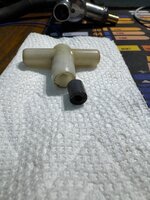
MAP vacuum block - integrates all 4 cylinder vacuum connections
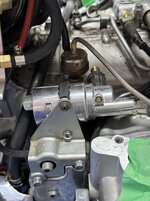
Aftermarket FPR valve - maintains system pressure at approximately 40 PSI
Dual O2 sensors, one for each cylinder bank - provided by MaxxECU, integrate nicely with the MaxxECU

Recent Addition(s):

IAC Motor - Walker product 215-1061

The OEM CFI IAC system will be completely removed. Mentioned in a previous post that the IAC system reed valves would be "gutted" and reused; however, this will not be the case. Has to do with supplementary air supply hoses. It is recommended that these should be equal length to each cylinder. The original OEM CFI IAC hose routing goes to cylinder 2/4 first then to cylinders 1/3. This creates an imbalance where cylinders 2/4 get a better supplemental air supply than cylinders 1/3. Small issue but needs to be addressed.

The new configuration will be the new PWM IAC motor supplying supplemental combustion air to a vacuum/mixing block, supplemental air hoses to each cylinder, equal length. The recommended supplemental air hose ID is 5 mm. Have to admit that I'm using AI for a lot of the leg work and have to sift through the information to make an informed decision. Looked at some pictures I have of a stepper motor IAC installation and the 5 mm size should work.

The installation of the IAC and crank trigger wheel should be the final component change after which it's road trials, and enjoying the bike. Engine tuning will be ongoing, finding out nuances such as fuel injector offset/gain calibration will not impact on riding this old girl.

Cheers
 
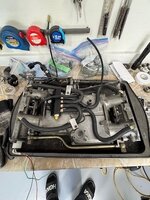
Have the air chamber out and the original CFI IAC system removed, IAC valve, water hoses. Bought a new Bosch NTC CLT sensor and have it installed. These don't last forever, so a small upgrade it is. Rad and right side timing belt removed waiting of the 36-1 trigger wheel.

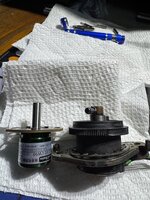
Bought a contactless, sometimes called a Hall effect, TPS. Since I have a bit of time waiting for parts, I have been looking into contactless TPS, versus contact TPS. Always thought that when a TPS was contactless, it somehow did not have a mechanical shaft linkage between the throttle plate(s) shaft and the TPS. A mechanical shaft linkage will always for the foreseeable future, have a mechanical shaft linkage.

The contactless aspect is internal to the TPS. The older style of TPS use a metal brush - "wiper" that scrapes across a track inside the TPS. This is why a TPS can become faulty at certain RPM ranges. The wiper and track become worn.

A contactless TPS uses Hall effect technology. The twist of the throttle, a magnet turns over a stationary electronic circuit board without touching the circuit board, ergo contactless. It is because no moving parts interface, a contactless TPS should not wear out.

This new technology TPS unit is smaller than the original OEM CFI TPS. This TPS is 20 mm in diameter, the original CFI TPS is 30 mm:
OEM CFI TPS 4.jpeg
These TPS units come in varying activation degrees such as 90, 120, or 360 for example. Regardless of the activation degree, when not installed the shaft will rotate easily through a range of 360 degrees. You must also ensure that the TPS rotation is the same as the original. For my project, the TPS must rotate CW, will be confirming.

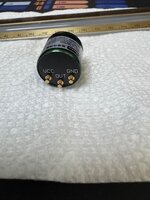
The unit I am going to install has the contact pins identified and these pins are made to have the contact wires soldered to these pins:
TPS 2.jpeg

The TPS I am using has a "throw" of 90 degrees, even though the shaft will rotate through 360 degrees. You have to connect the new TPS to a 5V reference and turn the shaft CW until the voltage starts to move from a base of 0.5V. This is the idle setting for the TPS. Continue turning the shaft until the voltage maxes out at 5V.

Most electronic geeks know that if you cut one end off a USB cable, strip back the sheath, there are red (power) and black (ground) wires. Plug this modified cable into a charging brick, you have a 5V supply. I did not know this but tried it, and it works!

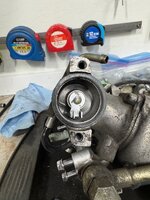
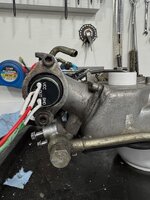
This unit will take a bit of finagling to get it installed. Have to make an adapter plate, and a connector for the "tang and fork driver system". Apparently this is what it is called, have to call it something:
OEM CFI TPS 3.jpeg
Next step(s) is to make the adapter plate and "tang and fork driver system" connector called a "drive tang collar", and determine where the TPS min/max limits are (mark TPS). The exact position of the min/max limits is not as critical as with the OEM CFI system. The OEM CFI system needed the calibration to be quite exact whereas in the MaxxECU Sport you calibrate the TPS in the fully closed and open position. The MaxxECU then determines a voltage range from "0" to 100 percent based on these two voltages.

Cheers
 
Back
Top