• There were many reasons for the change of the site software, the biggest was security. The age of the old software also meant no server updates for certain programs. There are many benefits to the new software, one of the biggest is the mobile functionality. Ill fix up some stuff in the coming days, we'll also try to get some of the old addons back or the data imported back into the site like the garage. To create a thread or to reply with a post is basically the same as it was in the prior software. The default style of the site is light colored, but i temporarily added a darker colored style, to change you can find a link at the bottom of the site.

Have any of you added an Aux Tank to a 2020+ RT?

I did do what I call a "proto type" test. I filled both tanks as full as I could get them, then rode 250 miles as fast as the speed limit would allow, some 75mph. I visited friends, then returned the 250 miles after refilling the tanks. No problems. I will be adding a shut off valve so that I can easily take the aux tank off if needed. I do have an inline fuel filter on the Aux tank line.

I leave in the morning at 0500 for Western Colorado. That will be a "real" test.

These machines mpg is influenced greatly by mph and wind. I can get near 40 mpg at 50 mph with no wind. Increase to 75 mph, 32 mpg maybe. Throw in a wind and 28 mpg looks good. There is a lot of frontal area.

My good ol' VTX 1300R was very consistent. MPG did drop some with speed, or should I say increased with less speed. I did drop some mpg with wind, but not enough to make me walk. But it had no fairing, just a windshield, and chaps on the highway bars.
 
Aux Tank Up Date:
I just returned from a 2600 mile trip to Colorado and New Mexico. 106°F on the return. Everything worked fine until on the way home at the 106°F temps, when I guess I had a vapor lock in the Aux line. Only half of the aux tank made it to the main tank. By morning, all of the fuel had transferred. I'll need to reroute the lines and/or insulate. On the way out, I ran into over 100°F temps with no problems. Maybe 105°F is the limit. LOL

In the mountains, my MPG was 40+mpg. Slow speeds. At one point, just after a fill up, I saw 300 miles to Empty on only the main tank. That didn't last long.
 
In the mountains, my MPG was 40+mpg. Slow speeds. At one point, just after a fill up, I saw 300 miles to Empty on only the main tank. That didn't last long.
Most likely due to the ECU adjusting the air/fuel ratio due to the change in air pressure at the higher altitudes.
 
@jdgretz I think that pump idea and arrangement works well. I would adapt that to the tank up high on the pillion seat area, get a metal shop to make the replacement mount cover to be sturdy, tank easily removed and not worry about filling one before the other etc. Def use an evap tie-in to relieve tank pressure and vapors as it would be in the sun a lot. Plus with a 5 gal tank, you would get near 500 miles before having to fillup both tanks. That would work for me. :)
@jdgretz what pump and plumbing did you use?
Sorry to take so long to get back to this. I now am the proud owner of a slightly used (28 miles on the clock) 2024 Spyder RT Limited.

The Goldwing used a small Carter Marine style pump that is around 20gph flow rate. Steel braided fuel lines with a quick disconnect at the aux tank (Summit Racing). The whole thing was wired to a lighted switch on the side panel. The tank came from Summit Racing and was foam filled to prevent sloshing (basically a dragster gas tank).

Looking at the maintenance manual for the Spyder, it looks like I might be able to put a "t" fitting into the fuel return line on the pump. I'm thinking the Show Chrome trailer hitch along with their Cooler Luggage rack may be the right setup for what I want to do. Need to figure out the fuel line routing so that the flexing of the suspension doesn't mess with the fuel lines.

jdg
 
From my service manual:

P0443 ECM Canister purge valve open circuit
P0458 ECM Canister purge valve shorted to ground
P0459 ECM Canister purge valve shorted to battery +
I believe that if you just leave the purge solenoid plugged into it's electrical connection, the Spyder will not know what is going on with the canister and hoses. Or the solenoid can be removed and a resistor inserted, taking place of the solenoid. Measure the resistance of the solenoid and get a resistor of the same value. I know there are bypass kits available for Kawasaki motor cycles that have the resistor in a plug to take the place of the solenoid and rubber plus some that go in the throttle bodies/intakes.
 
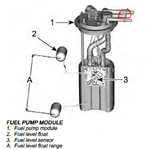
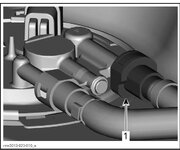
It looks like the fuel pump has a closed off nipple between the main fuel line and the return line. Does anyone know what that nipple is used for on another application? If it is a vacuum line, that would be great for the aux tank. If it is a simple pass through, that would be even better. I don't think it is a vent as the tank is vented in another location.

Fuel Pump.png The red circle is the nipple in question.

jdg
 
It looks like the fuel pump has a closed off nipple between the main fuel line and the return line. Does anyone know what that nipple is used for on another application? If it is a vacuum line, that would be great for the aux tank. If it is a simple pass through, that would be even better. I don't think it is a vent as the tank is vented in another location.

View attachment 253455 The red circle is the nipple in question.

jdg

In other vehicles and applications without a separate tank vent, that is the vent line that goes to the charcoal canister. This port is blanked off, or just not drilled out at all, for the Spyder’s pump module. There’s nothing on it externally to blank it off, and it’s not open to atmosphere. You would have to remove the module and see what you needed to do to open it up. That little cylindrical portion on the top, that it goes into, might even be the internal rollover valve when used in a venting type application.

Screenshot 2026-02-09 at 9.40.12 AM.jpg
 
Last edited:
In other vehicles and applications without a separate tank vent, that is the vent line that goes to the charcoal canister. This port is blanked off, or just not drilled out at all, for the Spyder’s pump module. There’s nothing on it externally to blank it off, and it’s not open to atmosphere. You would have to remove the module and see what you needed to do to open it up. That little cylindrical portion on the top, that it goes into, might even be the internal rollover valve when used in a venting type application.

View attachment 253457

Thanks for that explanation. I'll be at the dealer tomorrow and will ask how much the pump costs. Maybe I can find a used one or a wrecked RT that has the tank intact.

jdg
 
Thanks for that explanation. I'll be at the dealer tomorrow and will ask how much the pump costs. Maybe I can find a used one or a wrecked RT that has the tank intact.

jdg
Ask dealer what other models use same pump/sending unit - added options
 
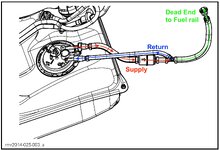
Turns out that pump is relatively inexpensive - under $300. However, the labor for installing it is more than that as the tank is a real PITA to get to. We looked at an F3 that he had apart and it looks like using the fuel return line is the best bet. I'll need to add a check valve so that I don't flood the bike when doing the fuel transfer, but the consensus of a couple of engineers/rocket scientists and my local tech is that it looks like that idea is the best option.

jdg
 
Turns out that pump is relatively inexpensive - under $300. However, the labor for installing it is more than that as the tank is a real PITA to get to. We looked at an F3 that he had apart and it looks like using the fuel return line is the best bet. I'll need to add a check valve so that I don't flood the bike when doing the fuel transfer, but the consensus of a couple of engineers/rocket scientists and my local tech is that it looks like that idea is the best option.

jdg
In this system, the fuel pressure regulator is an integral part of the fuel pump. It's not out on the fuel rail. It functions as a back-pressure regulator on the return line - modulating return line flow to regulate system pressure. During operation, the entire system, including the return line, will be at 60#. Even with the system shutdown, it holds pressure for a time and you'd have to exceed 60# during your transfer just to get the regulator to open and pass any fuel back into the tank. Otherwise, it will be closed, trying to raise the pressure. There's a check valve on the suction of the pump also, so you can't go back that path. I think I'd find another way.

1330 fuel system.jpg
 
Last edited:
In this system, the fuel pressure regulator is an integral part of the fuel pump. It's not out on the fuel rail. It functions as a back-pressure regulator on the return line - modulating return line flow to regulate system pressure. During operation, the entire system, including the return line, will be at 60#. Even with the system shutdown, it holds pressure for a time and you'd have to exceed 60# during your transfer just to get the regulator to open and pass any fuel back into the tank. Otherwise, it will be closed, trying to raise the pressure. There's a check valve on the suction of the pump also, so you can't go back that path. I think I'd find another way.

View attachment 253490
Boy, you are just no fun at all ;)

After talking with the tech, he agrees that adding a pump that will have more than 50psi to ensure positive fuel flow is probably not the best idea. There is some room both to the right and front of the fuel pump and maybe forward of the refueling opening to add a fitting. I'm really not thrilled about drilling into a tank that has fuel in it, or one that recently had fuel. Vapors and explosions in a confined area are not my friend.

I wish that tank wasn't so hard to get out. Adding a fitting to a new or used tank out of a totaled RT would not be that difficult. The time and labor involved in doing an R&R on the tank is going to be a killer. Summit Racing has all the parts I need. Now to find a reasonable way to make it work. Maybe finding an old fuel pump and drilling out that blank nipple is the way to go. We'll see.

jdg
 
Back
Top