I run the Vred 205/60 set at 15 PSI with 13 oz Ride-on on the back and Vred 175/55 set at 17 PSI with 8 oz Ride-on in each on the front. I used a Jaco digital inflator to air the tires and the same to check the pressures at the end. I weigh 145# and was carrying minimal cargo. This latest trip was 230 miles and the last leg was 60 miles after a brief fuel and pee break. When I checked the pressure first thing, I only got a 1.5 PSI increase on the front and a 2 PSI increase on the rear. The fronts are basically new and the rear is at .25 tread remaining. Do I dare reduce the pressure on these tires or is using Ride-on making the 4 PSI rule no longer valid? I have absolutely no issues with handling. Could it also be a validation on how well these tires are constructed?

-
There were many reasons for the change of the site software, the biggest was security. The age of the old software also meant no server updates for certain programs. There are many benefits to the new software, one of the biggest is the mobile functionality. Ill fix up some stuff in the coming days, we'll also try to get some of the old addons back or the data imported back into the site like the garage. To create a thread or to reply with a post is basically the same as it was in the prior software. The default style of the site is light colored, but i temporarily added a darker colored style, to change you can find a link at the bottom of the site.
You are using an out of date browser. It may not display this or other websites correctly.
You should upgrade or use an alternative browser.
You should upgrade or use an alternative browser.
Question about the 4 PSI rule for tire inflation
- Thread starter jjc54
- Start date

Snoking1127
Well-known member
I run 16 in my Vredestein fronts and 18-19 in my General out back. I ride both single and two up. I do not bother balancing the tires. This is a picture of the weights I just took on this low mile Kenda rear on the new to me 2018 RTL.
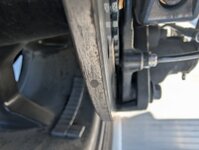

^^ See above!
I haven't actually tested the tire temps either, but I'd think that by adding Ride-on to the mix, you've probably at least markedly skewed 'the 4psi rule of thumb'!
Do you think you really need the Ride-on??
I haven't actually tested the tire temps either, but I'd think that by adding Ride-on to the mix, you've probably at least markedly skewed 'the 4psi rule of thumb'!
Do you think you really need the Ride-on??

BajaRon
Well-known member
I can't speak for the OP, but if you're asking me, Peter, I'd say there are definite advantages (and 1 potential disadvantage) to using Ride-On. I push hard for people to use the Automotive Ride-On even though Ride-On recommends the motorcycle version for the Spyder. Which makes absolutely no sense at all.^^ See above!
I haven't actually tested the tire temps either, but I'd think that by adding Ride-on to the mix, you've probably at least markedly skewed 'the 4psi rule of thumb'!
Do you think you really need the Ride-on??

EdMat
Well-known member
You have to remember it's a rule of thumb. Even if you disregard the Ride-on, you are lightly loaded and you don't mention the riding conditions. If you were riding hard in twisty conditions it would raise the pressure more than a leisurely cruise down some back roads. Based on my experience with the same tires you are too low in PSI already.
I agree with using the automotive version but my experience has been it is hard to find. In the past when I go to the Ride-on site you could not order from them. The only Ride-on I could find was on Amazon and only the motorcycle version.
My ride on the last leg was 55 miles of interstate at 70 mph and the last 5 were at 60. Air temp when I got off the bike was low 90's. Just checked my rear tire and the center is a little over 1/32 less than the outside. Just dropped my rear to 14.5 PSI.
My ride on the last leg was 55 miles of interstate at 70 mph and the last 5 were at 60. Air temp when I got off the bike was low 90's. Just checked my rear tire and the center is a little over 1/32 less than the outside. Just dropped my rear to 14.5 PSI.
I use it because I don't like the spare tire that comes with the bike (Ha)! I think it does a decent job of balancing and the people that replace my tire can't balance it. I need the rear changed soon and can't wait to see his mood when i go pick it up. I understand that it is very water soluble. If I remember right, I got introduced to Ride-on from this site!^^ See above!
I haven't actually tested the tire temps either, but I'd think that by adding Ride-on to the mix, you've probably at least markedly skewed 'the 4psi rule of thumb'!
Do you think you really need the Ride-on??
BajaRon
Well-known member
Ride-On is supposed to extend the life of the tire. It will be interesting to see if that pans out for you.I will also be able to do a longevity test as the last tire (same as this one) was balanced with weights!
Snoking1127
Well-known member
Not a good idea to run tires under inflated. Creates more heat and tires hate heat. Also there is a sweet spot in inflation regarding handling, and 14.5 might be below that point. When you install the new tire and have a few miles on it, place a piece of white paper on a smooth surface and drive across and then look at the pattern the tire left on the paper.My ride on the last leg was 55 miles of interstate at 70 mph and the last 5 were at 60. Air temp when I got off the bike was low 90's. Just checked my rear tire and the center is a little over 1/32 less than the outside. Just dropped my rear to 14.5 PSI.
BajaRon
Well-known member
I have to agree. There is more to life than how long a tire lasts. Like being alive to appreciate it. Going too low can create surprises that you may not like.Not a good idea to run tires under inflated. Creates more heat and tires hate heat. Also there is a sweet spot in inflation regarding handling, and 14.5 might be below that point. When you install the new tire and have a few miles on it, place a piece of white paper on a smooth surface and drive across and then look at the pattern the tire left on the paper.
We have had a customer come in with 7 lbs. in the rear tire. And another come in with 51 lbs. in his rear tire. That's the spectrium we've seen so far.

CloverHillCrawler
Well-known member
I found 15 to be the sweet spot on my rear quatrac. At 16 PSI I was starting to get a wear strip down the middle of the tire at 20K miles. Bringing the pressure down to 15 seems to have stopped that for now. I went on ahead and lowered my fronts to 15 as well. But 14.5 should not be under inflated. I also remember a thread on here where Mike said that either him or one of his buddies was running 11 psi at the drag strip with the rear tire.Not a good idea to run tires under inflated. Creates more heat and tires hate heat. Also there is a sweet spot in inflation regarding handling, and 14.5 might be below that point. When you install the new tire and have a few miles on it, place a piece of white paper on a smooth surface and drive across and then look at the pattern the tire left on the paper.
I found 15 to be the sweet spot on my rear quatrac. At 16 PSI I was starting to get a wear strip down the middle of the tire at 20K miles. Bringing the pressure down to 15 seems to have stopped that for now. I went on ahead and lowered my fronts to 15 as well. But 14.5 should not be under inflated. I also remember a thread on here where Mike said that either him or one of his buddies was running 11 psi at the drag strip with the rear tire.
That's ^ all good value info!

I've run 8 psi in a few of my tires for a few specific circumstances when achieving high traction for relatively short periods was necessary; but generally, the recommendation is not to go below 14 psi. The 'normal' recommendation for normal car tires on Spyders of 18 psi (but that's definitely NOT recommended for the lightly constructed poor quality controlled OEM Kendas, Kanines, XPS, or any of their clones, which NEED their listed pressures just to function as poorly as they do!) is not under-inflated; in fact, for a light rider/load who is not riding/cornering too hard, who's not always travelling fast, riding on high temp surfaces, or in high ambient temps, it might be a little high, as suggested above - but I still wouldn't recommend going any lower than 14 psi for long, or while riding hard!


racoon
Well-known member
So I'm a bit confused about this supposed 4 psi rule. I've never heard of it.
I went and checked the Operators Guides (plural), and they all recommend
Front: 138 kPa / 20 psi
Rear: 193 kPa / 28 psi
And by "all" I mean I checked the 2023, 2024, and 2025 Spyder RT Operators Guides I have downloaded to my computer.
What am I missing?
I went and checked the Operators Guides (plural), and they all recommend
Front: 138 kPa / 20 psi
Rear: 193 kPa / 28 psi
And by "all" I mean I checked the 2023, 2024, and 2025 Spyder RT Operators Guides I have downloaded to my computer.
What am I missing?
So I'm a bit confused about this supposed 4 psi rule. I've never heard of it.
I went and checked the Operators Guides (plural), and they all recommend
Front: 138 kPa / 20 psi
Rear: 193 kPa / 28 psi
And by "all" I mean I checked the 2023, 2024, and 2025 Spyder RT Operators Guides I have downloaded to my computer.
What am I missing?
Your missing the fact that those recommendations are for Kenda OEM tires, and because of their lightweight & unreliable construction, you REALLY don't want to vary too far from them.

But if you are running real car tires on your Spyder instead, then you REALLY don't want to run those same pressures in them, as the better/stronger car tires are somewhat more capable of carrying a load and would only need those sorts of pressures if they were fitted to a car weighing maybe 3 times as much - hence the recommendation for running 18 psi in real car tires when they're fitted to our 'much lighter than a car' Spyders.
If you want specifics on the 4 psi rule of thumb, search on that here and spend a few days reading; or you could search on the internet and get even more to read - there's a significant amount of info around on it.

mecsw500
Well-known member
So far my XPS branded Kendas fitted to my 2026 S2S have been a significant improvement over the original Kendas. They seem to have a better sidewall so they are a better match to the shocks and don't give that soft collapsing feeling in the twisty bits that makes the initial compression in the corners feel all mushy. They do need around 20/28 psi though, it's true.That's ^ all good value info!
I've run 8 psi in a few of my tires for a few specific circumstances when achieving high traction for relatively short periods was necessary; but generally, the recommendation is not to go below 14 psi. The 'normal' recommendation for normal car tires on Spyders of 18 psi (but that's definitely NOT recommended for the lightly constructed poor quality controlled OEM Kendas, Kanines, XPS, or any of their clones, which NEED their listed pressures just to function as poorly as they do!) is not under-inflated; in fact, for a light rider/load who is not riding/cornering too hard, who's not always travelling fast, riding on high temp surfaces, or in high ambient temps, it might be a little high, as suggested above - but I still wouldn't recommend going any lower than 14 psi for long, or while riding hard!
I've had ample chance to test them in heavy rain and either the compound or the tread pattern, or both, have changed and made a huge difference to wet weather handling. They handle triple digit temperatures better, they don't get that greasy feeling of the originals when it's hot. They do have a decent feeling as they get towards the limit, they don't suddenly break away on you. I think BRP and Kenda put a little more thought or money into these and not before time. Mine are certainly balanced with fewer weights and now actually run true.
They say they will last longer, and for that we will have to see. The votes out on that. Probably not.
Are they better than car tires? Probably not, for the correct brand of car tire, but they are nowhere near bad enough to want to rip them off and replace them at the outset. I'd say they are about on par with cheap OEM tires that come on any new car or motorcycle, good enough but not something you might put on again when they wear out.
I've ridden them on twisty poorly surfaced roads at 10,000 feet in cold torrential rain at 35-40F, and at lower altitudes at over 100F in the desert regions. I've done freeway miles on them too. All two up loaded with luggage. They've not given me any scary issues so far. I might be lucky with experience of just one set though of course and therefore lucky on the quality front.
The Kendas I had on my 2021 RT LTD were pretty awful in the cold and wet and the sidewalls were too weak. They didn't like the heat either.
Kenda is a weird brand. Their passenger car tires seem to get pretty rubbish reviews, but their truck and off road tires seem to be reasonably regarded from a value for money perspective in their Kenda Klever range and they got good Consumer Reports reviews. I've seen them on a few trucks and jeeps around here both on and off road.
I suspect the problem is BRP forces Kenda to produce something for a particular price point as a supplier for the Spyder and in this latest XPS version they perhaps raised the price limit a little due to the number of warranty returns.
Yeah, @mecsw500, while this is really somewhat off 'the 4 psi Rule question' that's the actual topic of this thread, I understand that you feel the XPS versions might be better than the latest Kendas, and I know that even those latest Kendas were a little better than all the earlier versions (who else remembers the crappy 2013/14 offerings?! ) but all indications are that the XPS are simply another small step up from the latest Kendas, but still with many of the same issues that all the OEM Kendas have had in some degree, and that the majority of reasonable quality car tires are at least another level above that, far more above if you go for even better quality tires! And I do realise that there were some Spyder owners out there who've never had any issues with the original Kendas either, albeit they appear to be largely riders who didn't really expect too much from their tires, or simply didn't (or maybe still don't) know any better.
So while I'm glad that you've found BRP's latest XPS offerings to be an improvement over their more recent Kendas, I feel that you should remember that there was a pretty significant gap between the 'black round things that might keep the metal bits off the ground' level of those latest OEM Kendas and that of the wear/performance provided by a quality 'real' car tire; so even with the slightly better tread that your XPS tires might apparently come with, giving it a bit better feel on the road, overall, their performance, longevity, and production quality are arguably still a fair bit short of what most expect from a tire that costs as much as BRP seems to expect us to pay. There are STILL people finding XPS branded Kenda OEM tires on their brand new Spyders that simply aren't anywhere near 'round', that don't run true, or that have other significant issues! So I certainly haven't been impressed by them - appalled, yeah, but not impressed!
So I'm glad you're happy - myself, and so far, everyone I personally know here in Oz who has actually made the step to upgrade to a better quality tire and then run it at an appropriate pressure for the lighter loads so that they truly understand what a good tire actually feels like on a Spyder, we are all not in the least impressed with the latest XPS offerings. Maybe it's just that we expect more from our tires than you might; maybe the conditions we ride in are harder on tires than where you ride, we certainly don't have too many roads like your Interstate 'slabs' or 'super slabs' - I really don't know about that; but personally, I'm not prepared to put MY safety OR the safety of anyone riding with me/around me on such a poorly performing tire, nor am I prepared to pay what is effectively a premium price for a such tire.
Just Sayin'
And now we should probably return to the real topic of this thread - the 4 PSI Rule...
) but all indications are that the XPS are simply another small step up from the latest Kendas, but still with many of the same issues that all the OEM Kendas have had in some degree, and that the majority of reasonable quality car tires are at least another level above that, far more above if you go for even better quality tires! And I do realise that there were some Spyder owners out there who've never had any issues with the original Kendas either, albeit they appear to be largely riders who didn't really expect too much from their tires, or simply didn't (or maybe still don't) know any better. So while I'm glad that you've found BRP's latest XPS offerings to be an improvement over their more recent Kendas, I feel that you should remember that there was a pretty significant gap between the 'black round things that might keep the metal bits off the ground' level of those latest OEM Kendas and that of the wear/performance provided by a quality 'real' car tire; so even with the slightly better tread that your XPS tires might apparently come with, giving it a bit better feel on the road, overall, their performance, longevity, and production quality are arguably still a fair bit short of what most expect from a tire that costs as much as BRP seems to expect us to pay. There are STILL people finding XPS branded Kenda OEM tires on their brand new Spyders that simply aren't anywhere near 'round', that don't run true, or that have other significant issues! So I certainly haven't been impressed by them - appalled, yeah, but not impressed!
So I'm glad you're happy - myself, and so far, everyone I personally know here in Oz who has actually made the step to upgrade to a better quality tire and then run it at an appropriate pressure for the lighter loads so that they truly understand what a good tire actually feels like on a Spyder, we are all not in the least impressed with the latest XPS offerings. Maybe it's just that we expect more from our tires than you might; maybe the conditions we ride in are harder on tires than where you ride, we certainly don't have too many roads like your Interstate 'slabs' or 'super slabs' - I really don't know about that; but personally, I'm not prepared to put MY safety OR the safety of anyone riding with me/around me on such a poorly performing tire, nor am I prepared to pay what is effectively a premium price for a such tire.
Just Sayin'
And now we should probably return to the real topic of this thread - the 4 PSI Rule...
Similar threads
- Replies
- 9
- Views
- 2K


- Replies
- 6
- Views
- 723


- Replies
- 21
- Views
- 3K


- Replies
- 15
- Views
- 3K
