• There were many reasons for the change of the site software, the biggest was security. The age of the old software also meant no server updates for certain programs. There are many benefits to the new software, one of the biggest is the mobile functionality. Ill fix up some stuff in the coming days, we'll also try to get some of the old addons back or the data imported back into the site like the garage. To create a thread or to reply with a post is basically the same as it was in the prior software. The default style of the site is light colored, but i temporarily added a darker colored style, to change you can find a link at the bottom of the site.

Is my Battery failing? Or not?

amkrat

Active member
I hesitated to start a new thread on a subject that has permeated this site quite thoroughly but breaking into the middle of someone else's thread might not get the answer I'm looking for. A Yuasa 350cca battery was installed in my 2024 RT-L in October 2024. It has always been on a tender when not in use. I did not know of the requisite 8 hour charging prior to use at the time. The Spyder has always started quickly and reliably. Now I'm reading here that a battery is failing if cranking voltage drops below 11.9 V or so. I thought I'd better check mine so I took it off the tender for 24 hours and started it. Voltage dropped for just a split second to 11.1 then climbed back quickly to over 12 then 14.4 when it started. Starter cranked and engine fired normally. I'm having a hard time believing that my battery is failing. Before I possibly needlessly replace this battery, I have to ask. Is it too late to do that 8 hour charging and will it prolong the life of the battery? I took a video of the start sequence but I'm apparently not smart enough to figure out how to attach that. Some sage advice from Baja Ron please.
 
Well, I will answer. But there are much smarter people here than I.

Does your battery tender have a desulfonate process? Sometimes, especially when the operational charge cycle has relatively long stagnant intervals, a sulfur compound can build up on the lead plates inside the battery. This not only reduces the amount of energy the battery is able to store, but also restricts the delivery in heavy load situations like starting the engine.

I don't know that 11.9v is the realistic cutoff point. But 11.1 is definitely too low under load.

When the electric motor gets less than needed amperage (volume), it will turn slower and with less authority. This will tend to reduce your electric pressure (voltage) quickly. But as soon as the load is removed, the voltage will jump back up.

If your tender does not have a desulfonating component, I highly recommend getting one that does and trying that out. If it saves your battery for a few more years, it will pay for itself.

If your current charger does have a desulfonating circuit, then your battery may be dying at a young age. One of the reasons we exclusively use dry shipped batteries is that a battery starts to age as soon as the acid is added. If it is not initially charged correctly, that can shorten its life. If it sits on the shelf for an extended time without charging before you purchase it, that can shorten its life as well.

The Spyder is a very power hungry machine. It requires a very healthy battery to work well. While most vehicles are much more forgiving in this area. Done correctly with the correct battery, you should see between 5-7 years of reliable service.
 
Last edited:
I'm not a fan of using a maintainer 100% of the time when not riding. I used to be, but learned a hard lesson several years ago. When leaving for an extended multi-day tour I packed the bike, unplugged it, started it, (it started normally) and rode about 350 miles during nice summer weather. The next morning, I checked out of the motel and tried to start the bike. There was zero voltage! It acted as if there was no battery in the bike at all (but there was). Called a local dealer who arranged to have my bike towed. The battery was completely DEAD!!! My charging system checked out perfectly. Just a bad battery and it wasn't very old. The tender masked my failing battery which was only taking a surface charge. Enough to get me started right after unplugging but not enough to last. These small batteries only need a small hiccup to fail. Since that incident, I only plugged my bike in when it will not be ridden for a few days or longer. Then, if getting ready to ride, I would unplug the tender a day ahead of time. Finding out your battery is failing while on the road and 350 miles from home is not fun......
 
I'm not a fan of using a maintainer 100% of the time when not riding. I used to be, but learned a hard lesson several years ago. When leaving for an extended multi-day tour I packed the bike, unplugged it, started it, (it started normally) and rode about 350 miles during nice summer weather. The next morning, I checked out of the motel and tried to start the bike. There was zero voltage! It acted as if there was no battery in the bike at all (but there was). Called a local dealer who arranged to have my bike towed. The battery was completely DEAD!!! My charging system checked out perfectly. Just a bad battery and it wasn't very old. The tender masked my failing battery which was only taking a surface charge. Enough to get me started right after unplugging but not enough to last. These small batteries only need a small hiccup to fail. Since that incident, I only plugged my bike in when it will not be ridden for a few days or longer. Then, if getting ready to ride, I would unplug the tender a day ahead of time. Finding out your battery is failing while on the road and 350 miles from home is not fun......
Nice post, you saved me all that typing!!! 😊 I am not a fan of the keeping it on the tender, for the same reasons as you!!! If your battery's good it will roll over and start if it's been sitting for weeks, it's when you roll it over and it turns slower than normal that's when you keep your eye's and ears open, and if you take it for a ride and it still rolls over slow, have it LOAD tested! I want it to not start in my garage, rather than at the gas station! Keeping it on a tender will give you a false impression of your battery health! If you are going to let it set of a couple weeks, I would take it off the pacifier and let it sit, then go try to start it, just for kicks, or you could have it load tested like said above!:cool: Good Luck!
P.S I had to jump on the soap box and do the typing anyway! 🙃 🤣
 
So, now we need to talk about the difference between a tender (trickle charger) which can overcharge (which can cause the sulfur buildup I mentioned above) and do damage when used constantly (as described by canamjhb), and a float charger which monitors the batteries charge and compensates down to zero input when the battery is fully charged.

People tend to interchange these terms, when actually, they represent very important and different charging applications. You will pay more for a charger with a good float circuit. But it may be well worth the extra dollars.

The difference is important if you just want to hook up your battery when you get home and not unplug it until you ride again.
 
The trouble is, very old people like me tend to call everything a trickle charger whereas these days what we really mean is a battery maintainer with float capability and other advanced protection capabilities built in. The abilities to detect the battery type is also assumed.

Like you imply, correct nomenclature is important. I for one will try to do better.
 
The trouble is, very old people like me tend to call everything a trickle charger whereas these days what we really mean is a battery maintainer with float capability and other advanced protection capabilities built in. The abilities to detect the battery type is also assumed.

Like you imply, correct nomenclature is important. I for one will try to do better.
I understand. Not on my hobby horse with this one like I am with the belt dampeners. Using lazy termenology and being inconsistant seems to be present in most of us. But we all have our Red Lines in the Sand, I suppose.

I'm not so much concerened for what people call these chargers. As long as they know there are differences in the 'Battery Maintaining' world. And they know what the differences are. Certainly not trying to get on anyone about it.
 
Allright, let's say that a new float charger is recommended. I see NOCO Genius chargers (with desulfinating circuit) for sale but are rated anywhere from 1 to 10 amps. Which one is appropriate for a Can-Am battery? They seem to be all out of stock on the NOCO website. My local Cabela's has 5 amp chargers in stock. Would that be overkill?
In the meantime, I think I will remove the battery, charge it overnight, and load-test it in the morning.
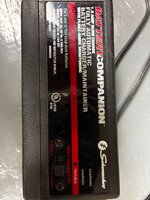
But wait! What do I charge it with? My battery tender, or my automotive charger that I use to charge car batteries? I don't want this thing to explode on my work bench overnight! I have been using a Schumacher 1.5 amp battery charger/maintainer with float mode monitoring. Will the battery hooked up to this provide a full charge by morning?

IMG_0471.JPG
 
Last edited:
Allright, let's say that a new float charger is recommended. I see NOCO Genius chargers (with desulfinating circuit) for sale but are rated anywhere from 1 to 10 amps. Which one is appropriate for a Can-Am battery? They seem to be all out of stock on the NOCO website. My local Cabela's has 5 amp chargers in stock. Would that be overkill?
In the meantime, I think I will remove the battery, charge it overnight, and load-test it in the morning.
But wait! What do I charge it with? My battery tender, or my automotive charger that I use to charge car batteries? I don't want this thing to explode on my work bench overnight! I have been using a Schumacher 1.5 amp battery charger/maintainer with float mode monitoring. Will the battery hooked up to this provide a full charge by morning?

View attachment 255883

As Ron suggested, I'd go with a 2 amp charger if you can, maybe your automotive charger, especially if it's got a small/motorcycle battery setting &/or an AGM setting on it. Ideally, you'd do this bit, but then re-install the battery in the Spyder and let it sit for at least the next day before repeating the load test and seeing what the results from that 'check the voltage while cranking' thing say. (y)

It's important that you start with your battery fully/properly charged before load testing it, but as others have mentioned, taking it straight of the charger/tender and then testing it, or worse, starting it up and riding away, can actually give you a false sense of security and leave you thinking your battery is still OK when it was really just the surface charge that let you get started, and you still might risk your battery failing to be able to start your Spyder once you get a long way from home/help/recovery! 😣

As for 'Needing' to replace your battery right now, that might not be essential, altho seeing 11.1 volts while cranking definitely suggests your battery is on its way out - but how much are you prepared to risk? :unsure:

If you ONLY ride to places where there's support and access to replacement batteries, and you NEVER stop out in the boondocks, then maybe you can risk sticking with the battery you've got, knowing that it's 'less than optimal', but it's still cranking OK, and if it does fail on you, you'll be likely to be able to replace it and continue on &/or get home, then maybe... :rolleyes: But remember, once these batteries DO fail (and the signs are that yours is heading that way!) then there's the chance that no amount of 'jumping' will get you going again, and we KNOW from the many reports here (and for some of us, thru somewhat difficult personal experience! :cautious:) that the next likely result of this 'dying battery' thing you're now experiencing the very first signs of will likely be a cascade of weird errors, inexplicable codes, VSS Interventions, &/or Limp Home Modes, so if you're prepared to risk it, then maybe you can continue on for a while, maybe even a fair while - but it IS an increasing risk the longer you persist with that dying battery, are you prepared to take that risk?? 😳

Over to you! Good Luck. (y)
 
Back
Top